Strawberry Hill: The Gothic Mansion of a 18th Century Nepobaby
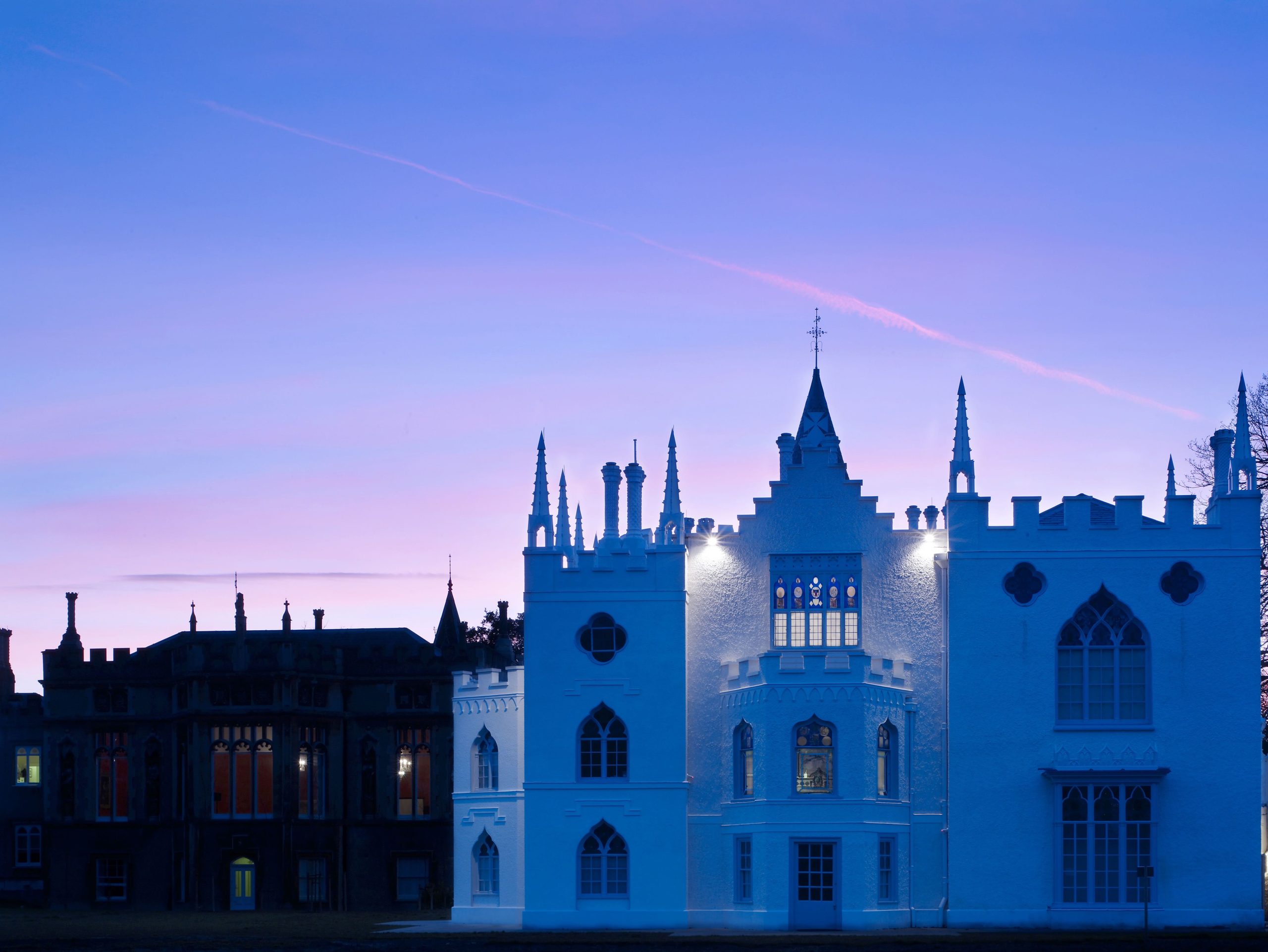
I recently had the chance to visit the fantastic Strawberry Hill House, often described as the foremost example of the Gothic Revival in Britain. It belonged to Horace Walpole, the son of the first prime minister, Sir Robert Walpole. As the third son of an influential nobleman, Horace got all sorts of government gravy train jobs from his father and therefore had quite a bit of time to spend on a Neo-Gothic summer mansion. My friend Jorunn calls him the ultimate 18th-century nepobaby.
In upper-class circles, he was considered a gifted man of letters and someone with a keen interest in aesthetics and antiquities, as well as an equally keen wit and nose for gossip. Strawberry Hill was famous in its own time, too, and Walpole had to entertain droves of guests eager to see the spooky Gothic mansion.
He also wrote novels, and his most famous work is tied so closely to Strawberry Hill that it can be considered as part of the same promotional package, the first English Gothic novel: The Castle of Otranto. He reportedly was inspired to write the novel after awaking from a nightmare in his mansion, and seeing an apparition of a massive armoured hand hovering above the bannister. Walpole published the book in 1764 through his private printing press. He was the first person in England to privately own such a machine (see, Jorunn is right). When you visit Strawberry Hill, the house library prominently displays an early edition.
Inventing Strawberry Hill: A “Plaything House”
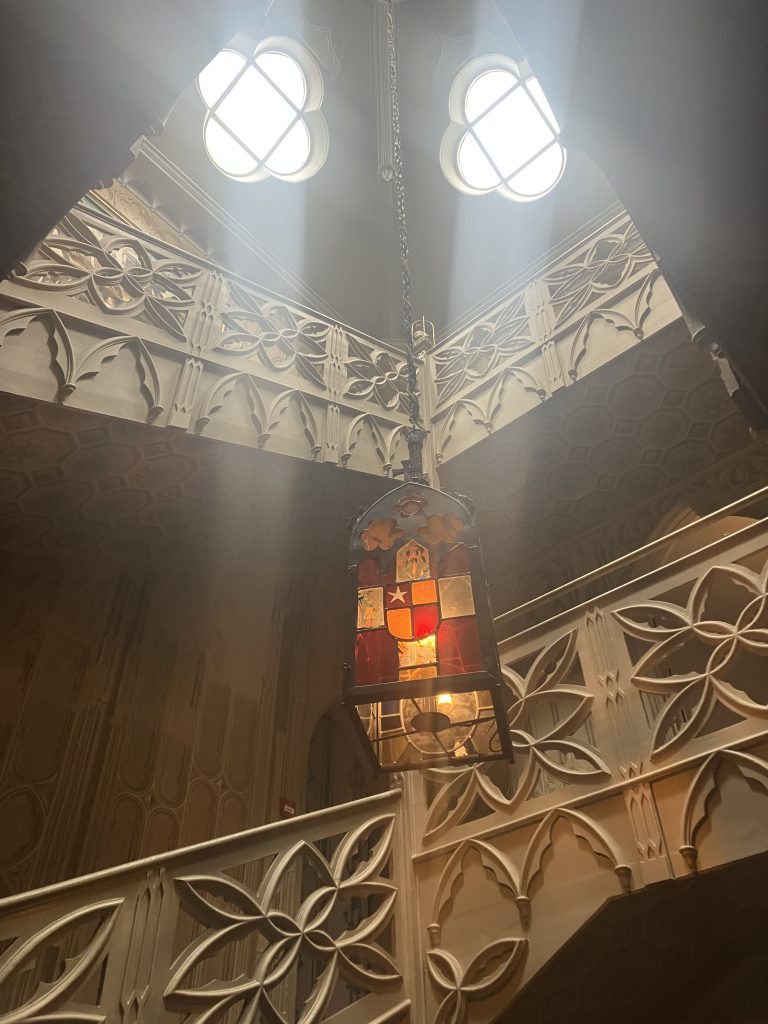
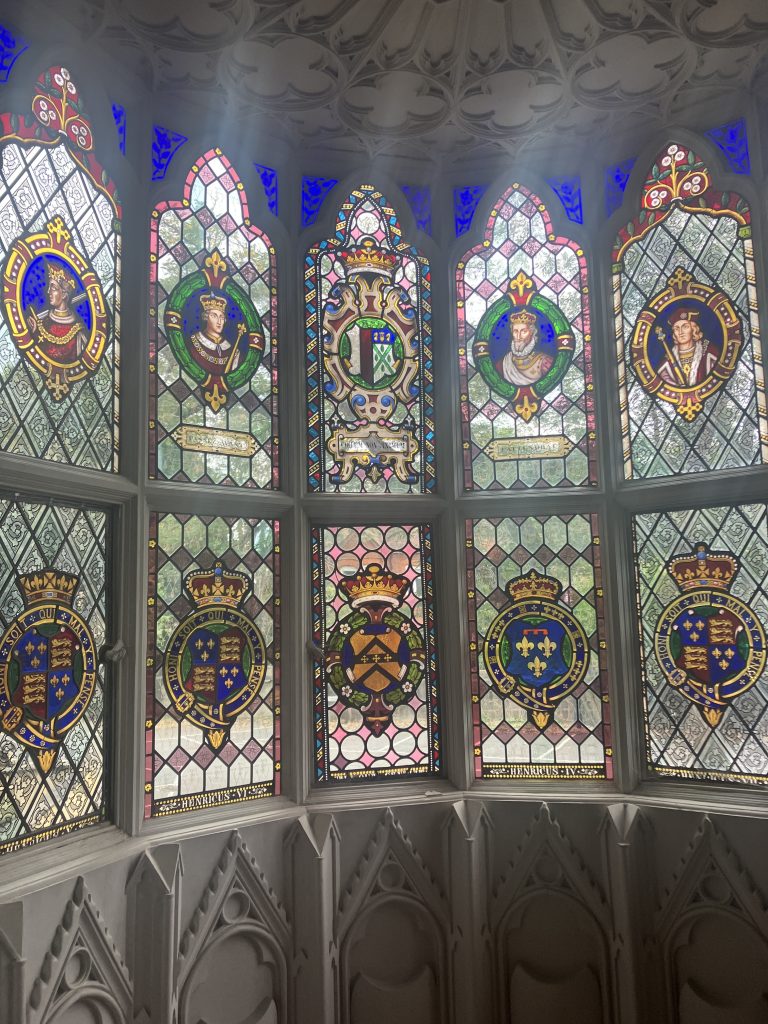
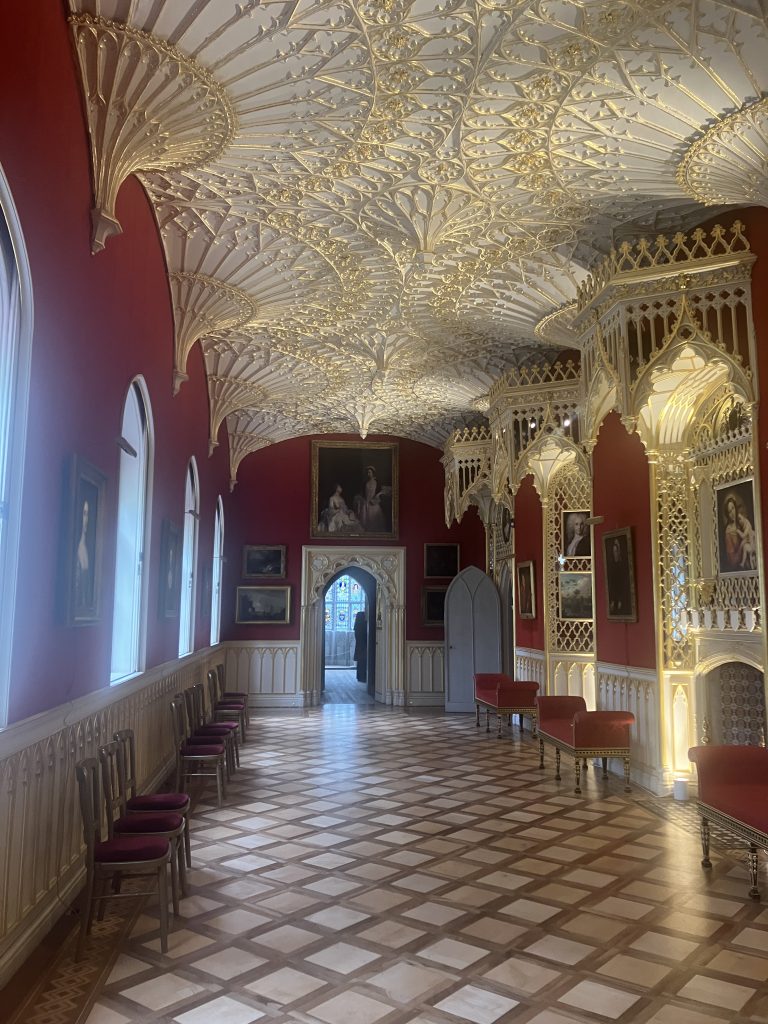
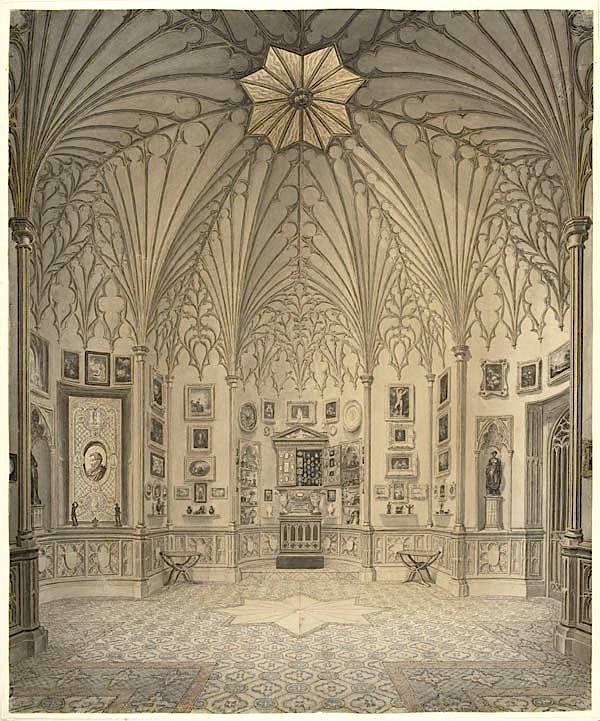
As you probably gather, you should not come to Strawberry Hill expecting it to be a gloomy mansion reflecting a tortured mind. Walpole himself referred to it as a “plaything house.” Far from being a depressed gothic baron, he was a self-aware, charming, and, in many instances, camp individual. When he bought Strawberry Hill, it was just a boxy building, but he transformed it into a mini-medieval castle through pinnacles, battlements, and a round tower. Inside, he commissioned a grand chimneypiece for the parlour, stained glass windows throughout the house, and a staircase for the entrance hall. He filled the house to the brim with an eclectic collection of antiques and oddities, like a lock of Mary Tudor’s hair or Thomas Wolseley’s hat.
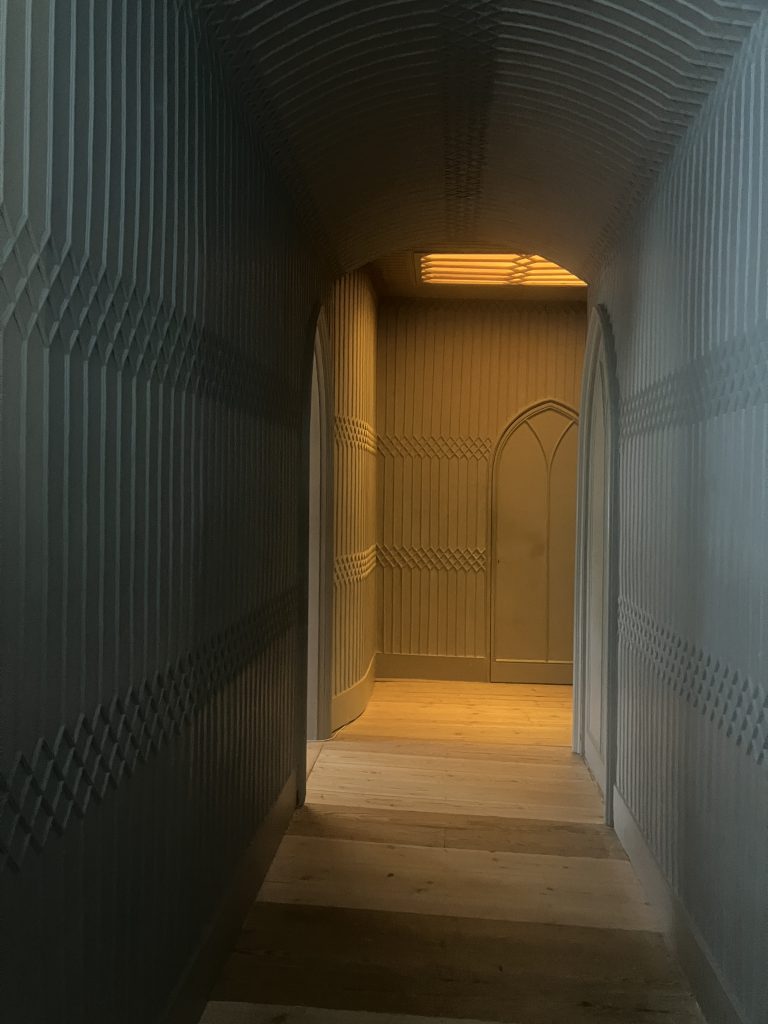
When I visited the house, I could not help but think how obviously fake it was. The grand chimney is actually wood painted to look like stone. The ceiling decorations in the long gallery are plaster made to look like marble and gold. All partly cost-saving measures, but also evidence of Walpole’s awareness of exactly what look he wanted. Strawberry Hill really impresses you with the power of a constructed aesthetic and imagery shorthand. Walpole seems to have been incredibly aware of what made a decorative item or interior design signal a specific feeling. Gloomy hallways, medieval-looking chimneypieces, arched and decorated ceilings: by themselves, they can conjure monasteries, medieval knights, chivalry, or fairy tales. He knew what each item would mean individually in our cultural imagination, but also the impression of it all together. Taken as a whole, the impression is uniquely ‘Walpole.’
The ‘constructed’ nature of Strawberry Hill is mirrored in Walpole’s preoccupation with social persona and image. As mentioned above, Walpole was an avid letter writer, and we have some 7000 letters he wrote throughout his life to his numerous correspondents. He diligently maintained friendships solely through letter-writing for years, often until the recipient died. His dedication to correspondence, coupled with the house, his art collections, and his Gothic novel, gives a distinct impression of a man who wanted to be remembered: Kept alive in friends’ memory or through his eccentric Gothic taste enshrined through Strawberry Hill.
The Walpole Extended Universe
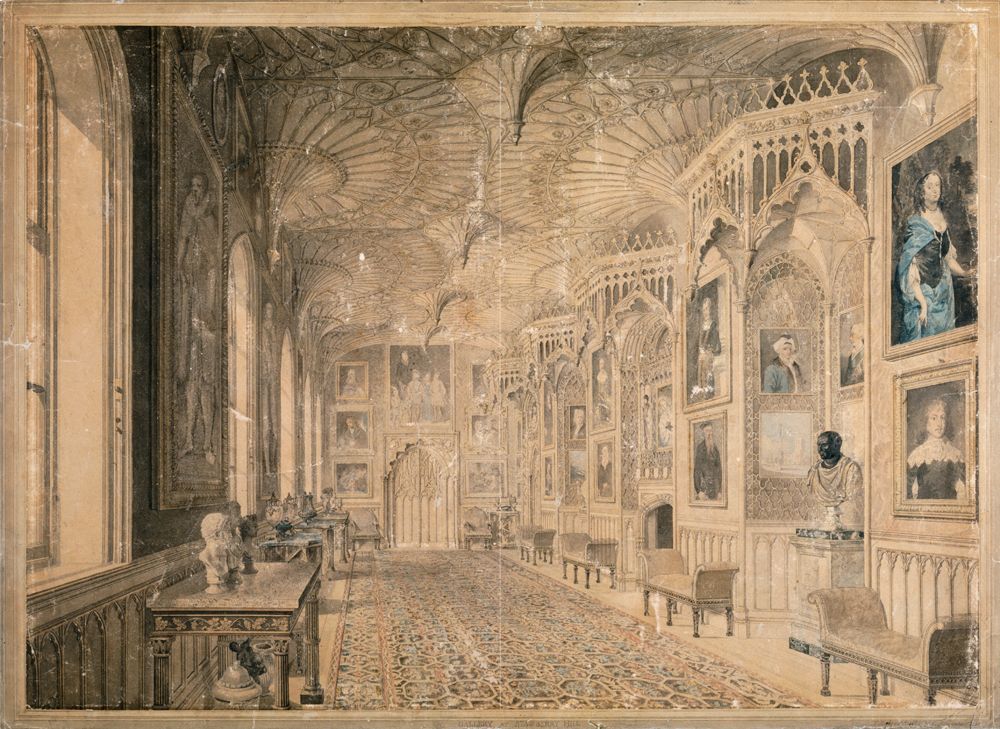
Although the architecture of Strawberry Hill is impressive, very few of Walpole’s paintings, books, antiques, and furniture are left. In 1842, Horace Walpole’s descendant, George Waldegrave, sold off all the items in the house to pay for his mounting debts, later known as The Great Sale. The fate of all of Walpole’s antiques, bits, and baubles is perhaps ironic: they were essentially sold off to pay for the lifestyle of another extravagant aristocrat, showing the funds required to indulge in image-building.
The lack of decorative items in the rooms, especially if you have visited the John Soane museum or any of the grand country houses outside London, can be stark, but the curators of Strawberry Hill have done a great job in acquiring the most unique pieces again or displaying replicas. As mentioned, Walpole had a supreme awareness of a room’s image. Often, the plaster cathedral ceilings or faux-stone fireplace can carry the room’s story on its own, no antiquities required. However, I would argue that a lot of heavy lifting is done by the existence of The Castle of Otranto.
As I toured Strawberry Hill with my friends, we were asked by a guide if any of us had actually read Walpole’s book. I said I had, and was then asked how I had managed, since it was so awfully boring and confusing. Although I have found myself defending a lot of 18th-century literature as an occupational hazard, I couldn’t in good faith mount a defence here. Anyone reading the novel expecting an enduring classic will be disappointed. The Castle of Otranto is not by any means scary, gory, or sensational by today’s standards, even if it was considered such in its time. The novel might actually be more enjoyable when you keep in mind Walpole’s witty letter-writing, reading more melodrama and camp into the novel than horror.
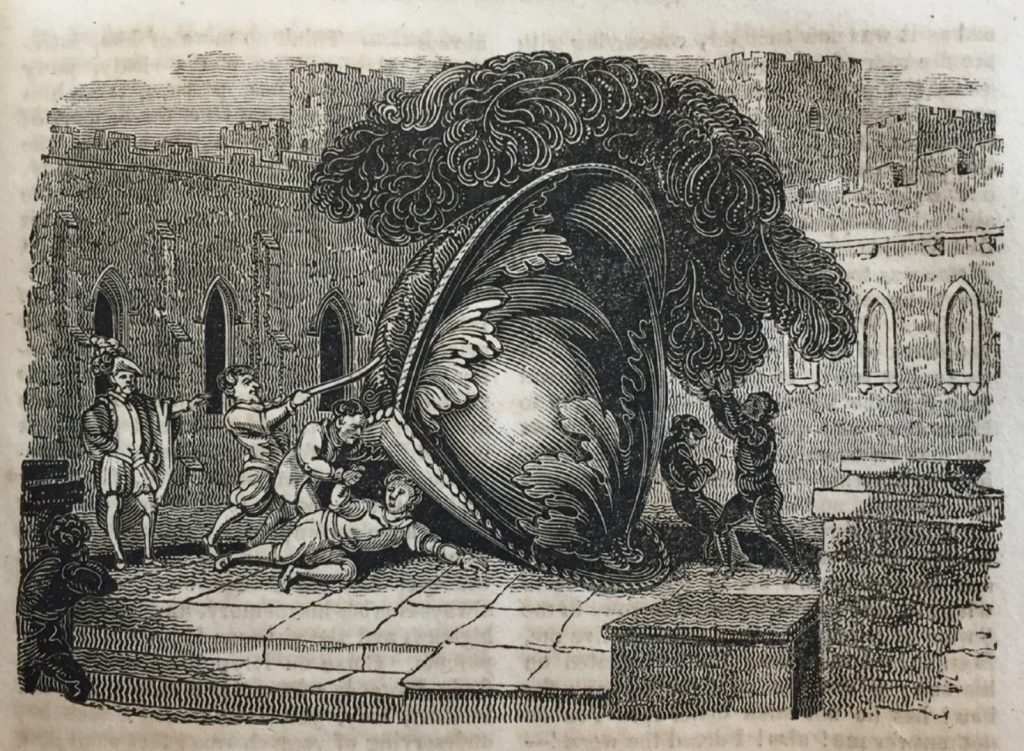
The novel tells the story of Manfred, a tyrannical prince who becomes obsessed with preserving his dynasty after his son, Conrad, is killed when a giant helmet falls from the sky. As statue-like ghosts haunt Otranto, Manfred attempts to pursue and marry his dead son’s bride to obtain a new heir. Walpole’s use of a haunted castle, an ancestral curse, and an evil patriarch would later be codified as hallmarks of Gothic literature. Not only that, Walpole did not present himself as the author but instead invented an editor who had ‘translated’ the tale from a medieval manuscript. The idea of a found manuscript became a popular trope in Gothic literature and survives today in the Horror genre as the “found footage” movie.
Like with his mansion, Walpole seems to be supremely aware of what certain tropes, devices, or images would signify in the literary imagination. Because of its early use of now familiar tropes, the novel endures as a historical artefact and, as is clear when you visit Strawberry Hill, as a part of the extended Gothic universe of Horace Walpole.

“The Kitchens Alone Are Real”
Strawberry Hill is then, to sum up, the perfect simulacrum of a Gothic, perhaps haunted, house. It is as if any one of us were asked to list features we expect to see in one, and lo and behold, Strawberry Hill would have 9 out of 10. In 1923, M.R. James published “The Haunted Doll’s House,” in which the titular toy house is in the style of “Strawberry Hill Gothic.” It is not surprising that a miniature medievalist castle would be the inspiration for a haunted dollhouse. As Walpole himself said, it was practically already a playhouse, perfect to stage the supernatural drama of his own Gothic writing or M.R. James’s almost 200 years later.
I should say that not everyone has been a fan of Strawberry Hill House or of Walpole’s taste over the years. Augustus Pugin, Victorian architect purist, generally disliked all Gothic Revival that prioritised ornamentation for its own sake. Walpole’s medieval-for-medieval-sake mini-castle must have been a potential aneurysm. In 1841, coincidentally, one year before the Great Sale by Walpole’s descendant, Pugin wrote a takedown of all mansions in the ‘Abbey style’:
The seemingly abbey gate turns out a modern hall, […] the apparent church nave is only a vestibule; the tower, a lantern staircase; the transepts are drawing -rooms; the cloisters, a furnished passage; the oratory, a lady’s boudoir; the chapter-house, a dining -room; the kitchens alone are real; every thing else is a deception.
The True Principles of Pointed or Christian Architecture, 59
Sound familiar? The fake church nave and the lantern staircase certainly sound like Strawberry Hill. Although I do not know for sure, I like to think that Walpole and his house at least strayed into Pugin’s mind. Walpole passed away in 1797, so he could not experience being read like this, but given his love of gossip and ability to be equally acid, I think he would have enjoyed it. I imagine that Walpole would easily agree with Pugin’s comments on the constructed nature of Gothic Revival houses, even maybe say: That’s the fun of it!
Pugin does point to a material constant of a house: The Kitchen – the unavoidable feature of even the most Gothic of homes. We all have to eat. However, when I visited Strawberry Hill, there was no visible kitchen. Perhaps it has been removed or is now part of the (equally needed) museum cafe? Even so, Pugin’s comments and the lack of a kitchen in Strawberry Hill House made me think about Walpole’s fantastical construction and the ‘fakeness’ of his Gothic vision. It is amusing to imagine him contending with something so mundane as a kitchen amongst all his plans for the long gallery, staircase, and parlour. Of course, it also reveals Walpole’s privilege, the assumptions about what counted as a valuable use of time for the upper class, and the general unconcern for material needs.
Actually, an 18th-century milkmaid named Ann Yearsley shared similar views on Walpole and The Castle of Otranto. She even wrote a sarcastic poem in response, commenting on the class and gender politics that shaped Walpole’s real and literary world. If you are curious about this, I have it all written up here.
Otherwise, do visit Strawberry Hill House. It is great fun.